Caroline & Whitaker Calloway · Baptism · Sunday 27 June 2027 · St. Cecilia’s Chapel, Charleston

Two worlds for Eloise’s baptism

Sunday, the twenty-seventh of June, at St. Cecilia’s Chapel on Legare Street. Here are two complete directions for the day’s stationery. They are not two versions of one idea — they are two different objects, and choosing between them decides what the card is actually for.

The difference, in one line One world puts almost no ink on the page and stakes everything on the surface of the paper itself. The other puts no relief on the page at all and stakes everything on a drawn line you already own. One is the chapel at eleven o’clock. The other is the bowl on the sideboard.
Direction A · the first world
the world you tilt to the light

The Still Font

Almost no ink. One ring of relief pressed into soft-white cotton rag, and Eloise’s name small at its centre — where the water was broken.

Struck, not printed One colour, used sparingly No drawing anywhere No metallic Read by tilting it to the light

The chapel has no colour in it. St. Cecilia’s is a small early-nineteenth-century Episcopal chapel of stuccoed brick, set back behind a wrought-iron gate on Legare Street: lime-washed walls, a plain Palladian window over the altar, worn heart-pine floors, and a shallow marble font by the south door. At eleven on a June Sunday the light comes through that window as one soft sheet and lands on the water — and for a moment the water is completely still. This world makes the card that moment, and spends the whole craft budget on the sheet and on one inkless strike into it.
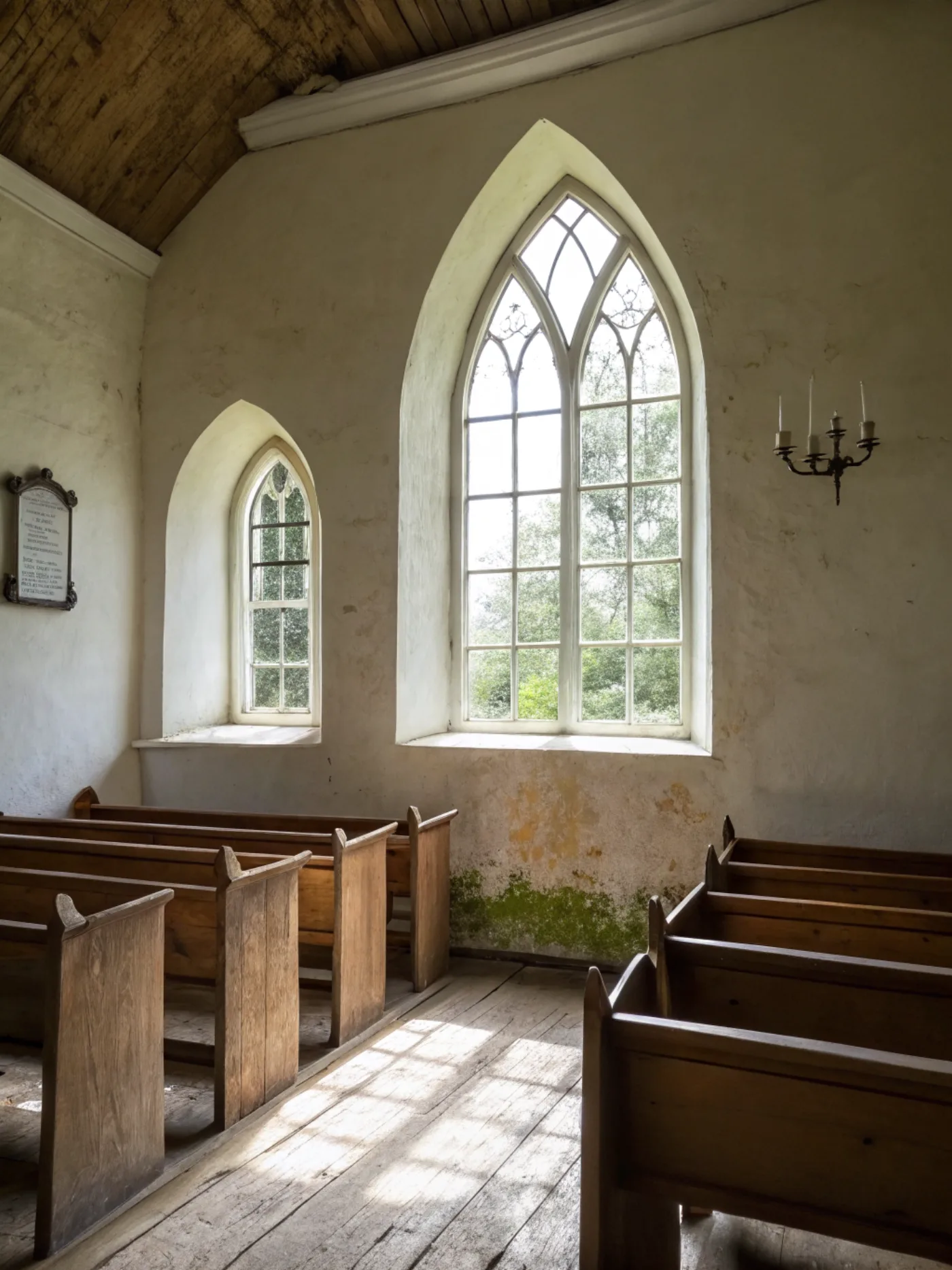
— The Still Font · the argument
The interior of a plain country chapel: lime plaster, pointed windows of clear glass, oak pews, morning light.
Chalk
#F6F3ED
Ground — every piece
Slate
#3D4750
Ink — the only one
the mark — one true circle inside one true arch, set with a compass and a straight edge
Type specimen
BAPTISM
display — Bodoni Moda, tracked as an inscription
St. Cecilia’s Chapel
text — Jost, every practical line
a drafted face and a geometric sans — and no script at all
the same strike, menu-sized — the arch as a hairline, still carrying no ink
Shell
#DCD6CB
Shadow — the deboss
Still Water
#9AA7AF
Relief only, never type
“No colour in the glass, no colour anywhere but the flowers and the water.” — the chapel, from the briefing
The ideaThe card is the surface of the water, a moment after it was still.
Made byOne blind strike into a heavy rag, and one slate ink used sparingly.
TypeBodoni Moda and Jost. No script — there is no handwriting in this world.
ImageryNone at all. The only mark that is not a letter carries no ink.
RegisterModern, austere, and unmistakably made this year.
The moment the card is about — water that has just stopped moving. The lower two-thirds of the card is that surface: unprinted, carrying one blind-debossed ring with no ink in it.
Where the money goes — soft-white cotton rag at 600 gsm, deckled on the long edges. There is no foil, no second colour and no illustration, so the sheet has to carry the piece.
Why it is austere — the room is. Clear glass, lime wash, worn heart pine, and the light arriving as one broad sheet rather than a beam. Nothing in the chapel is decorated.
How this world lands, on each of the nine pieces
InvitationEverything a guest must read sits in the top third. The lower two-thirds is the water: unprinted, carrying one blind ring with no ink in it at all.
Save the DateThe ring alone, struck into a smaller sheet, with the date set beneath it and nothing else on the card.
Envelope & LinerNo liner at all — this world spends nothing on a surface only one person sees. The envelope is the same rag, addressed in slate.
Order of ServiceThe ring drops to the foot so the liturgy owns the page. The 1979 Prayer Book text is set plainly and never paraphrased.
Luncheon MenuThe arch as a single hairline down a tall page, never the ring — the ring belongs to the sacrament, not to lunch.
Place CardThe name and nothing else, set large enough to be read at arm’s length across the long table under the live oak.
Welcome SignThe arch cut life-size out of one board and stood at the chapel gate, unpainted, with the light doing the rest.
Favour TagA punched tag carrying the ring at its smallest, with the five wishes of the sugared almonds set beneath in three lines.
Thank You CardOnly the ring. No type on the face at all — the thanks are written by hand on the back, which is the one exception this world allows.
Across the dayNothing is looked at from across a room. Every piece has to be picked up and turned before it gives anything away.
At the pressOne blind strike and one slate ink, on a single stock. The whole craft budget is spent on the sheet and the impression.
What this world will not do Illustration of any kind · script or handwriting · gold, silver or any metallic · a second colour · pastel nursery register · type set over the debossed ring
Open this world in full
Still open in this world
  • Whether a card with almost no ink on it survives the post. The whole piece is one impression and a small name. A scuffed strike is the only thing that can go wrong, and there is nothing else on the sheet to look at instead.
  • Whether the ring reads as water. Nobody outside this conversation has been handed a blind ring on soft white and asked what they think it is.
  • Whether “no handwriting in this world” can hold for nine pieces. The thank-you cards get written by hand whatever the board says, so the rule has an exception built into it already.
Direction B · the second world
the world you already own

THE CHRISTENING BOWL

Your own bowl, opened out flat. The rim garden redrawn for this family, the clear glaze left open in the middle, and Eloise’s name written across it by hand.

Could the invitation just be the bowl, opened out flat? Caroline, on the telephone

One blue, three strengths Engraved line, never wash Dense at the rim, clear in the well Only what grows in the chapel garden No metallic

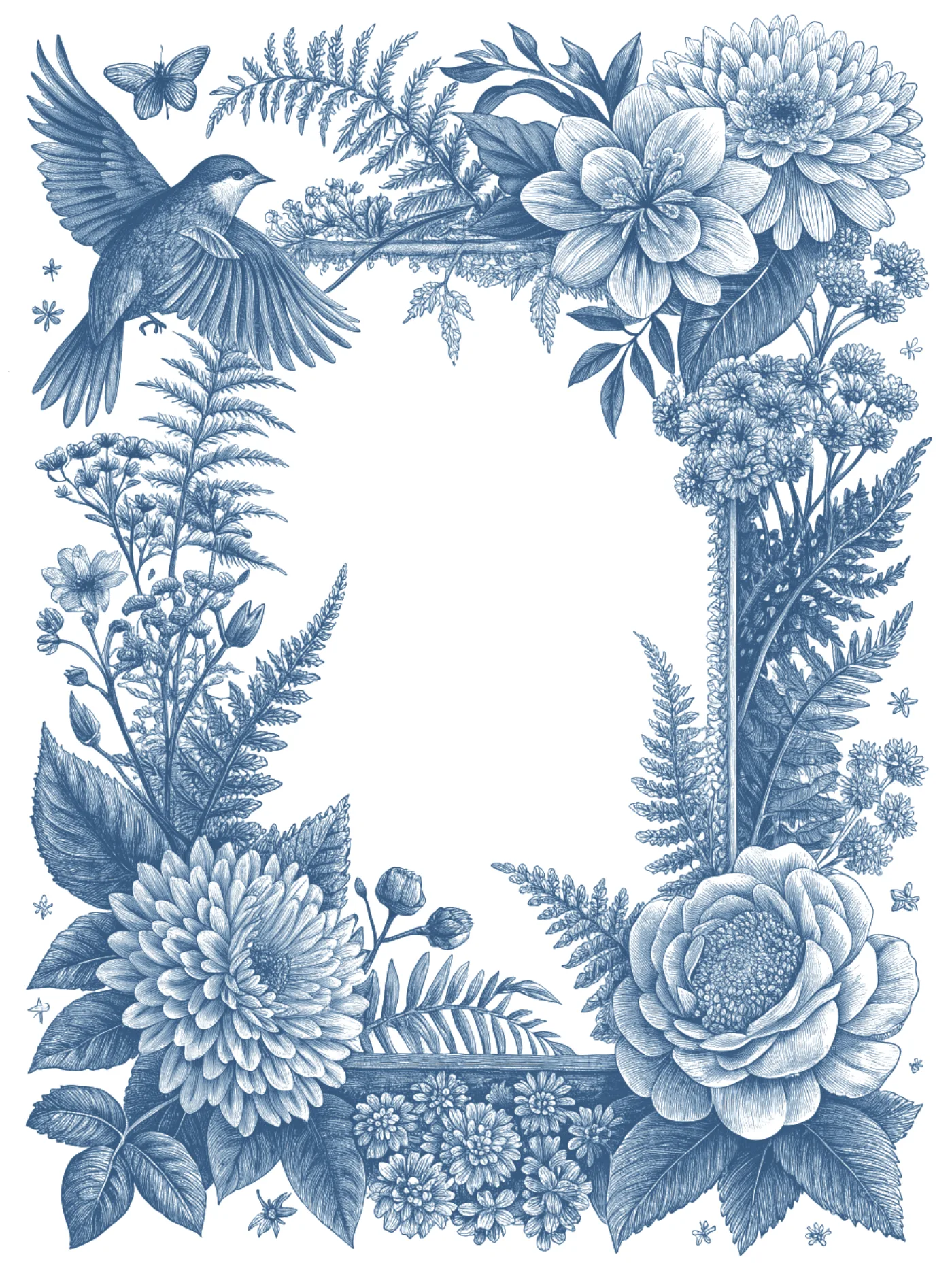
A blue-and-white Canton bowl has stood on the sideboard of the Legare Street house since Caroline’s great-grandmother brought it there. It is not valuable and it is chipped at the foot, and it has held the water at every Calloway christening since 1931 — Caroline’s grandmother, Caroline’s mother, Caroline herself, and now Eloise. Around its rim runs an engraved garden: dahlias, wild roses, sword ferns, berry sprigs, two swallows in flight and one small bird perched low on the left. The baby is named Eloise Wren, after that bird and after her great-grandmother Wren Calloway. This world takes the family’s own request literally.

— The Christening Bowl · the argument
The rim garden redrawn as a four-sided engraved frame: dahlias, wild roses, ferns, elderberry, a bird and a butterfly around an empty centre.
the wren — the bird on the rim and the child’s own middle name, drawn fresh as a Carolina wren
Porcelain
#FAF8F2
Ground — the glaze
Canton
#3F6389
Ink — at full strength
Type specimen
BAPTISM
display — Cormorant Garamond Light, tracked capitals
Eloise Calloway
the name only — one script, used once
a classical face of the bowl’s own period, and one hand
the running band — the same burin line and the same species, laid out as the rim runs
Delft
#5C80A6
Ink at 62% — display
Pale Glaze
#B9CBD9
Wash at 28% — flowers
letterpress from photopolymer, one blue at 100%, 62% and 28% — no foil, no emboss, no wax seal
The ideaThe invitation is the rim of the bowl that has held the water since 1931.
Made byLetterpress in ONE blue at three tint strengths on heavy rag. No metallic.
TypeCormorant throughout, with one script used once — for Eloise’s name only.
ImageryEngraved botanical line: only what grows in the chapel’s walled garden.
RegisterInherited, domestic, continuous — it will not look new.
The whole drawn vocabulary — nothing else is added and nothing else is invented
THE WREN
once per piece, never twice — and never on the order of service
THE SWALLOW
the birds that nest under the chapel eaves every summer
THE SPRIG
the smallest fragment — favour tags and place cards
THE CORNER
one corner only, where a full frame would be too much
THE BAND
a running edge — menus, programmes, the liner repeat
The object everything comes from — chipped, kept on the sideboard, in use for four generations. Its rim is the whole design brief, and the family asked for it opened out flat.
Where the plants come from — the chapel’s own walled garden in late June. Nothing from a stock library: no peonies, no eucalyptus, no pampas.
Not a copy of the transferware — that pattern is mass-produced, and copying it would be other people’s drawing. The same species and the same engraver’s line, drawn fresh.
How this world lands, on each of the nine pieces
InvitationThe whole four-sided garden, bled off all four edges, with the well left clear in the middle for the parents’ own words.
Save the DateOne corner spray and one sprig, and no bird — the pattern arriving months early, in fragment.
Envelope & LinerCalligraphy in the same blue on the face; inside, the garden as an endless repeat. The only surface where the pattern never stops.
Order of ServiceThe birdless band at the head and nothing else. The day is not about the bird, and the Prayer Book order is not paraphrased.
Luncheon MenuThe running band as a masthead on a tall four-by-nine page, carrying its one permitted bird.
Place CardOne sprig, with the name set around 21pt so it reads at arm’s length across a wide table to older guests.
Welcome SignThe whole garden for the second and last time, at eighteen by twenty-four inches, with the swallow.
Favour TagThe wren, alone, on a punched tag — the smallest the world ever goes, and the only piece she gets to herself.
Thank You CardOne wren and a corner held at a whisper, on an otherwise empty page. The garden has done its work.
Across the dayThe full frame is licensed twice and never again; every other piece takes a fragment, so the pattern never wears out.
At the pressLetterpress from photopolymer, one pass, one blue at 100%, 62% and 28%. Cheaper than it looks, and the reason there is no foil.
What this world will not do Storks, rattles, prams, baby-blue or cartoon animals · gold, silver or any metallic · a second accent colour · a heavy graphic crucifix · flowers that do not grow outside the chapel door · painted or watercolour rendering — this world is engraved line
Open this world in full
Still open in this world
  • Whether the rim garden can be drawn without becoming a wreath. Only what grows in the chapel's walled garden is the rule; laid as a band round an edge it is one step away from the thing every baptism card already does.
  • Whether three tint strengths of one blue is enough range. It is what keeps the world honest about a single colour, and it is also the entire tonal vocabulary for nine pieces.
  • Whether Eloise's name in a hand can be reproduced. One script, used once, for her name only is either a lettering commission or a typeface pretending to be one — and those cost and read very differently.

Where this went

The Christening Bowl was chosen, and all nine pieces were built out of it — the save the date, the envelope and its liner, the order of service, the luncheon menu, the place cards, the sign at the chapel gate, the favour tags and the thank-you cards. The Still Font was not carried forward.

True of both, whichever had been chosen No gold, silver or any metallic. No second accent colour. No pastel nursery register — no storks, no rattles, no baby-blue. One slim typographic cross as the only religious mark. Heavy soft-white cotton rag, deckled on the long edges. Nine pieces.

The choice

What the choice turned on

Both worlds are one colour on heavy soft-white cotton rag, both refuse metallic, and both run to nine pieces. What changes is whether the card is a surface you tilt to the light, or a pattern the family already owns.

A — The Still Font

You want the day’s stillness rather than its lineage — a card that will not look inherited, because it was made this year for this child. Almost nothing on the sheet, one ring struck into it with no ink at all, and a guest who has to pick it up and turn it to the light before it gives anything away.

B — The Christening Bowlbuilt

You want the object the family already has. A chipped Canton bowl has held the water at every Calloway christening since 1931; this world draws its rim garden fresh for Eloise, leaves the glaze clear in the middle, and writes her name across it by hand — so nothing about the day looks new.

 A · The Still FontB · The Christening Bowl
What the card isMostly unprinted paper, with the type in the top third.The rim of a bowl, opened out flat, with the type in the clear well.
How it is madeOne blind strike into 600 gsm rag — the mark carries no ink.Letterpress in one blue laid down at 100%, 62% and 28%.
ImageryNone at all. The only mark that is not a letter is inkless.Engraved botanical line — only what grows in the chapel’s walled garden.
TypeBodoni Moda and Jost. No script, and no handwriting anywhere.Cormorant throughout, with one script used once — for Eloise’s name.
Where her name goesSmall, at the centre of the ring, where the water was broken.Written across the clear glaze by hand, the way a plate is signed.
How it is readBy tilting it to the light — in flat light it gives almost nothing.At a glance; the pattern is doing the talking before the type does.
RegisterModern, austere, unmistakably made this year.Inherited, domestic, continuous — it will not look new.
RiskOne impression and a small name: a scuffed strike is the whole failure mode, and there is nothing else on the sheet to look at.A garden laid round an edge is one step away from the wreath every baptism card already does.

The Calloways chose B — the suite was built from it.