Twelve years of work, and one evening to mark it. Two ways to print a title that has never been printed before — one that trusts the words on their own, one that keeps the room they are read in. Both arrive at the same feeling: earned.
No decoration that cannot be made from type itself. The London Review of Books translated into an event suite, where restraint is the authority and white space says as much as the words — and “Dr.” sits alone on the first line, the first time it will ever be printed anywhere.
Twelve years: a first-class law degree from the University of Lagos, an MSc from UCL, three years of fieldwork across Sierra Leone, Liberia and Côte d’Ivoire, two more years writing, and a doctorate from the LSE on the legal frameworks governing post-conflict land restitution. The dinner is not for the thesis. It is for the thirty-two people who kept her going — a mother who flew from Lagos, a supervisor who came from Edinburgh, a best friend from law school who came from New York. This world answers that room the way a good jacket answers a good book: it says the name, it says nothing else, and it trusts you to know what it cost.
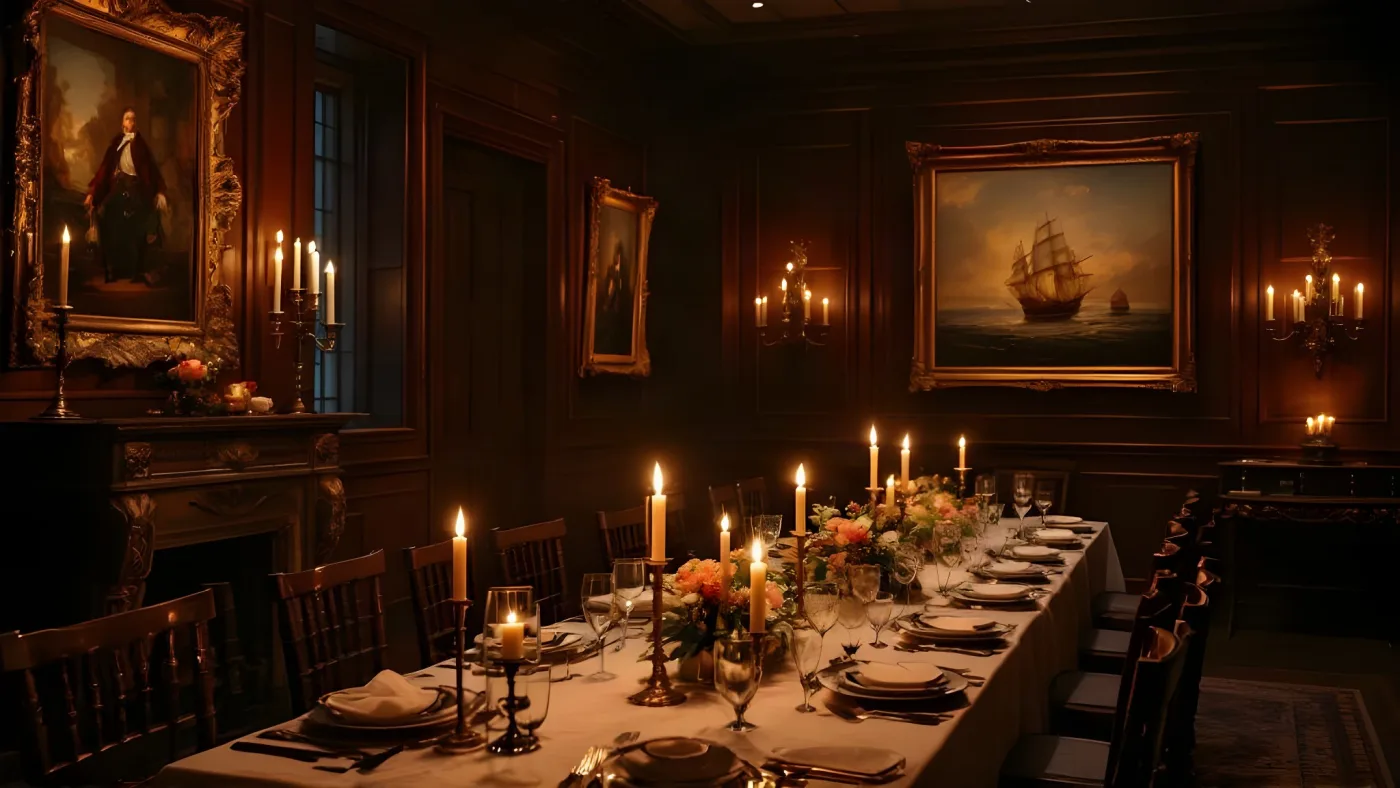
Trinity House at half past six — candlelight on dark mahogany, maritime paintings in gilt frames, a Georgian dining room readied for thirty-two people who crossed continents to be there. The atmosphere is felt rather than depicted, and the Ankara appears once, folded and held. An inheritance, not a display.
Trinity House is a Georgian livery hall on Tower Hill: deep panelling, maritime paintings in heavy gilt frames, a single table laid for thirty-two at half past six in July. Adaeze will be wearing a dress made from her grandmother’s Ankara — bright indigo and gold, the pattern that woman wore to every important occasion of her life. This world starts in that room rather than at the title. It sets the suite in the room’s own light, and it lets the fabric appear exactly once, folded, the way an inheritance appears: not on display, simply present.

The choice
Both worlds use the same four colours and the same two faces. One is read in the hand under a lamp; the other is read at a candlelit table. Drag the handle to see them against each other.
A · The Edition
B · The Archive
You want the title to do the work. A bare cream sheet, “Dr.” alone on the first line, one pressed cognac rule, and enough white space that the restraint reads as authority rather than thrift.
You want the evening to do the work. Charcoal stock in a candlelit Georgian hall, cognac behaving like the gilt on the frames, and her grandmother’s cloth present exactly once.
| A · The Edition | B · The Archive | |
|---|---|---|
| The first move | The title, set alone on a bare sheet. | The room, before a word is read. |
| Ground | Cream paper — read in the hand. | Deep charcoal — read at the table. |
| The display voice | EB Garamond upright, capitals tracked wide. | EB Garamond italic, softened by candlelight. |
| The Ankara | Abstracted to geometry down the left margin, six per cent. | One folded fragment, once in the whole suite. |
| Cognac’s job | Ink — a rule pressed into the sheet. | Light — the gilt on a picture frame. |
| Welcome sign | The first line, enlarged, and nothing else. | A dark board lit by the hall it stands in. |
| What survives | A card that reads like a first edition. | An evening that reads like a photograph. |
Direction A — The Edition — is the world that was built. All nine pieces descend from it; The Archive was not carried forward.
One note on how it was actually printed, since the board should not overstate its own rule: EB Garamond carries every name and every display line on all nine pieces, but a second face, Jost, carries the letterspaced small capitals on seven of them. “One family, set completely” is the argument — two faces, strictly ranked, is the execution.