One occasion, end to end

Éléonore & Maximilien

A wedding for a hundred and twenty at a Loire château, followed the whole way: the brief they filled in, the two worlds we drew from it, the one they chose, every piece that came out of that choice, and the evening as a guest met it.

WeddingChâteau de Marcilly, Amboise120 guestsTwelve delivered files, all openable below

Home  ·  The Showroom  ·  One occasion, end to end

01 — The brief

What they asked for, in their words

Éléonore and Maximilien met in the print room of the Bibliothèque nationale — she was researching 18th-century engraved trade cards for her doctorate, he was the conservator who kept extending her reading-room slot. He proposed seven years later in the same room. Everything below came out of one briefing form.

The occasion
A wedding for 120, at Château de Marcilly in Amboise — a 17th-century Loire Valley château with a mirrored orangerie for dinner.
The feeling
“A state occasion held in private.” The engraved invitations of the ancien régime re-set by a modern master. A private view at Christie’s, not a hotel ballroom.
The colours, in words
Warm ivory, antique gold, near-black ink, a single drop of Bordeaux.
The one motif
Her grandmother’s laurel-wreath brooch — “once per piece, small, like a watermark or an engraver’s mark, never as a border.”
The type
Bodoni Moda, named outright in the brief.
Materials
Cotton rag, engraved. Wax seal, gold edge gilding, tissue interleaving. Envelopes addressed by hand.
What to avoid
No blush pink or rose gold. No watercolour washes. No script-heavy layouts. No floral clip art. No gradients. “Nothing that could be mistaken for a spa brochure.”
Nine designs
Invitation · Save the Date · Menu Card · Place Cards · Table Numbers · Order of Service · Seating Chart · Custom Monogram · Itinerary Card.

Nothing else was asked of them. No consultation call, no mood-board homework, no shortlist of other people’s weddings to react to. The next thing they saw was two finished worlds.

02 — The choice

Two complete worlds. One question.

Not two colourways of the same card. Two different objects, from two different rooms of the same story — his and hers — so that choosing between them is a real decision rather than a preference for a shade. One is an impression printed; the other is an impression struck.

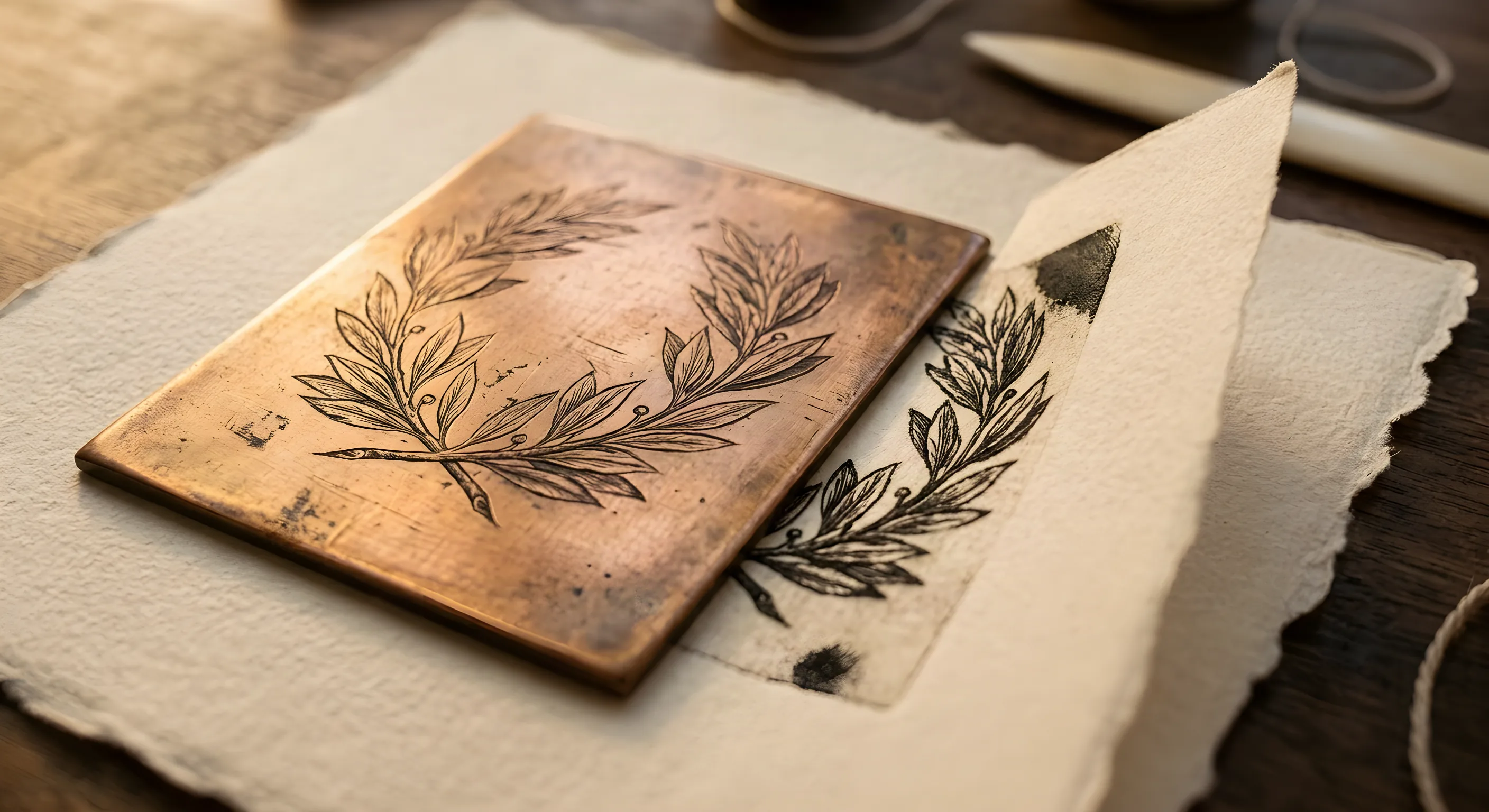
An engraved copper plate carrying a laurel wreath, with the first impression pulled onto deckled cotton rag beside it.

World A

The Proof

The invitation is not a finished object — it is the first impression pulled from the copper plate, kept because it came out perfect.

Drawn from Her doctorate: 18th-century engraved trade cards, studied in the print room where they met.

A6 flat card · engraving with a visible blind plate-mark · 600 gsm cotton rag, deckled · one gold hairline at the edge

  • Warm Ivory#F4EDE0
  • Antique Gold#B08D57
  • Bistre#3A3128
  • Bordeaux, reserved#6B1F2A
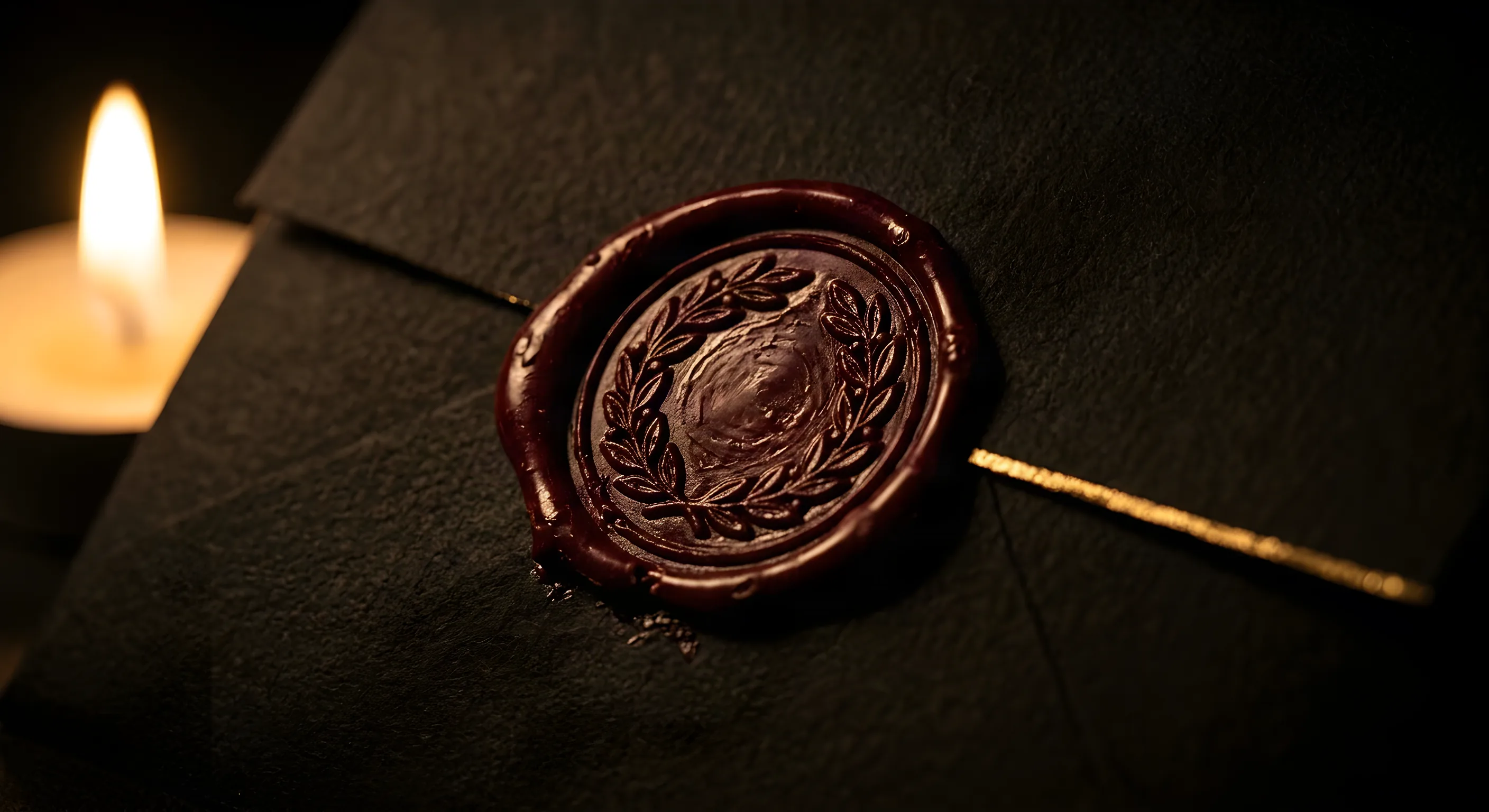
A near-black folio closed with a deep Bordeaux wax seal struck with a laurel wreath, lit by a single candle.

World B

The Night Seal

The same engraved hand after dark — a folio closed with one drop of Bordeaux wax, struck from a brass matrix, opened by candlelight in the mirrored orangerie.

Drawn from His collection: antique wax seals, and the brass matrices they were struck from.

Folio, 120 × 170 mm closed · dark cover, ivory inner leaf · Bordeaux wax seal on the cover · gilt fore-edge

  • Night Ground#181410
  • Candlelight Gold#C9A24B
  • Ivory Leaf#F4EDE0
  • Bordeaux Wax#6B1F2A

Both worlds are built in full before either is shown — palette, typography in use, materials and print production, the motif, the photography treatment, and how the world lands on the invitation, the suite, the signage and the guest’s arrival. The board ends with one line: Which world do you want built?

03 — What was built

World A, and the card it became

“The Proof” was the world taken forward. From it, nine invitation executions were drawn, each arguing a different reading of the same idea; the ninth — a director’s cut assembled from the strongest of the other eight — is the card below. It is called The Cipher, Struck Clean.

A6 portrait, 105 × 148 mm · engraved on 600 gsm cotton rag · a single gold hairline at the edge

Two things thrown away on the way here An early set of cards carried a laurel we had drawn ourselves rather than the engraved one from the approved board. It was close, and it was wrong: the mark a client approves is the mark that ships. Every card was rebuilt on the real one.

A later card laid a tissue overlay across the ground. It looked handsome and it was a wash — functionally a gradient, which this brief bans outright. It was removed and rebuilt as a deep plate deboss with a gilt fore-edge, which gets the same depth without breaking a stated rule.

Four galleries were built and reviewed before one card was locked. Nothing was overwritten on the way: each round was saved beside the last, so the decision can still be re-read.

04 — Everything after it

Eleven more pieces, all derived from that one card

Each piece below is the real delivered file, opened live — not a photograph and not a mockup. Every one inherits the same grid, the same two typefaces, the same ivory, the same single gold hairline and the same laurel. What changes from piece to piece is how much of that budget each one is allowed to spend.

Open the file →

Envelope

C6, 162 × 114 mm · two faces, front and sealed back

The wax seal is a closure, not decoration — so the front carries the laurel like every other piece, and the addressee is not left floating in an empty frame.

Open the file →

Envelope liner

108 × 150 mm, cut to the envelope interior · wordless

The richest surface in the suite after the invitation. The plate-mark and the cipher are dropped here so the laurel has the field to itself.

Open the file →

Save the date

A6 portrait, 105 × 148 mm — the invitation’s own trim

The monogram is withheld on purpose: the save the date promises a mark, the invitation delivers it.

Open the file →

Reply card

89 × 127 mm, returned by post in its own small envelope

Ruled blanks, not tick boxes — the suite’s icon set is deliberately empty, and a ruled blank is what a card of this period actually gave you. No gilding: gilding is reserved for the two pieces that announce.

Open the file →

Itinerary card

100 × 225 mm tall portrait · seven moments

Times are spelled out — “Half past seven” — so the card holds the same register as the invitation. Its laurel sits at the foot, because the menu already carries one at the head and no two cards in the hand should repeat the same gesture in the same place.

Open the file →

Order of service

A5 portrait, 148 × 210 mm · ten moments

The ten moments are distributed evenly down the page so the ceremony reads as a catalogue entry rather than a stack.

Open the file →

Seating chart

610 × 914 mm (24 × 36 in) · cut as vinyl lettering, applied to a mirror

Names first built at 16 pt left the bottom quarter of the board dead; raised to 20 pt until the twelve blocks fill the plate. What we supply the cutter is the ink layer — the mirror is the substrate.

Open the file →

Table numbers

100 × 130 mm standing cards · twelve, one per table

Each table is a Loire château, and the name is the design — it runs at 29 pt so it reads across a room, with the number receding beneath it. First built at 24 pt and rejected as too small from ten feet.

Open the file →

Place cards

90 × 55 mm, scored to stand as a tent · shipped as a set

One name, one mark, one hairline rule. The first build carried a boxed border, which contradicted the suite’s own drop list; the review caught it and it went.

Open the file →

Menu card

100 × 235 mm tall portrait · printed in English, dishes kept in French

No gold anywhere on this card: gold may not carry a word a guest has to read. Dish names are set at 9.5 pt with an explicit break at each semantic unit, so “vin jaune jus” never splits across two lines.

Open the file →

The cipher

120 × 120 mm · drawn live in SVG, so it scales without limit

Drawn as if cut for a real brass matrix — the groom collects antique wax seals. This is the one piece where the laurel is dropped entirely, because the cipher is the mark.

  • 9designs in the plan
  • 12files delivered
  • 1approved direction behind all of them
  • 2typefaces, across every piece

Nine designs were in the plan; twelve files were delivered. The envelope and its liner travel with the invitation rather than counting against it, and the reply card was added at review, when the suite turned out to have no way for a guest to answer on paper.

05 — The guest side

The same evening, from the other end

A guest never sees a suite. They see six or seven separate moments, weeks apart, and the only thing that tells them it is one occasion is that everything matches. This is the order the 120 met it in.

  1. Months out

    A save the date arrives, on the invitation’s own trim, carrying the laurel but not the monogram — the mark is promised, not yet delivered. See it →

  2. In the post

    A hand-addressed C6 envelope, sealed in Bordeaux wax. Opening it, the liner is the loudest thing in the whole suite — an engraved laurel filling the field, seen once and never again. See it →

  3. Inside

    The invitation, and with it the cipher the save the date withheld. Dates spelled out, RSVP kept off the card’s face, families co-hosting — the etiquette the brief asked for, not a house default.

  4. The reply

    A 89 × 127 mm card with ruled blanks and its own small envelope. A guest who would rather not post anything can reply online instead; both routes reach the same list. How replies are handled →

  5. At the door

    Their name on a mirror, in vinyl lettering cut from the same artwork, under the château their table is named for. See it →

  6. At the table

    A place card with their name at 16 pt, a standing card naming the table Chenonceau or Villandry, and a menu printed in English with the dishes kept in French.

  7. The ceremony

    Ten moments on one A5 page, evenly spaced — the prelude, the readings, the vows, the recessional — set to read as a catalogue entry rather than a list.

One design, every household’s own copy. Seven of these pieces also exist as per-guest editions: the same approved artwork, composed once per household with that household’s name, their language, their table and their address, and returned as print-ready files. It is the same design — it is not a different card for everyone.

07 — The point of all this

One decision, made early, that made every other decision

Éléonore and Maximilien made exactly one creative choice: which of two worlds to build. Everything on this page after that — twelve files, twelve table names, 120 seated guests, the wax, the gilding, the vinyl on the mirror — follows from it. Nobody had to approve a menu card, because a menu card was never an open question.

That is the whole argument for doing it this way. Most of the work of an occasion is not design; it is the hundred small decisions design keeps asking you to make. Answer the first one properly and the rest answer themselves.

Every file linked from this page is the delivered file itself, opened live from our archive — not a screenshot, not a re-render for the web. Guest names on the seating chart and place cards are the ones the couple supplied for their own event.

We use cookies and local storage to improve your experience and measure site performance. See our Privacy Policy.